Ledger Stone 1
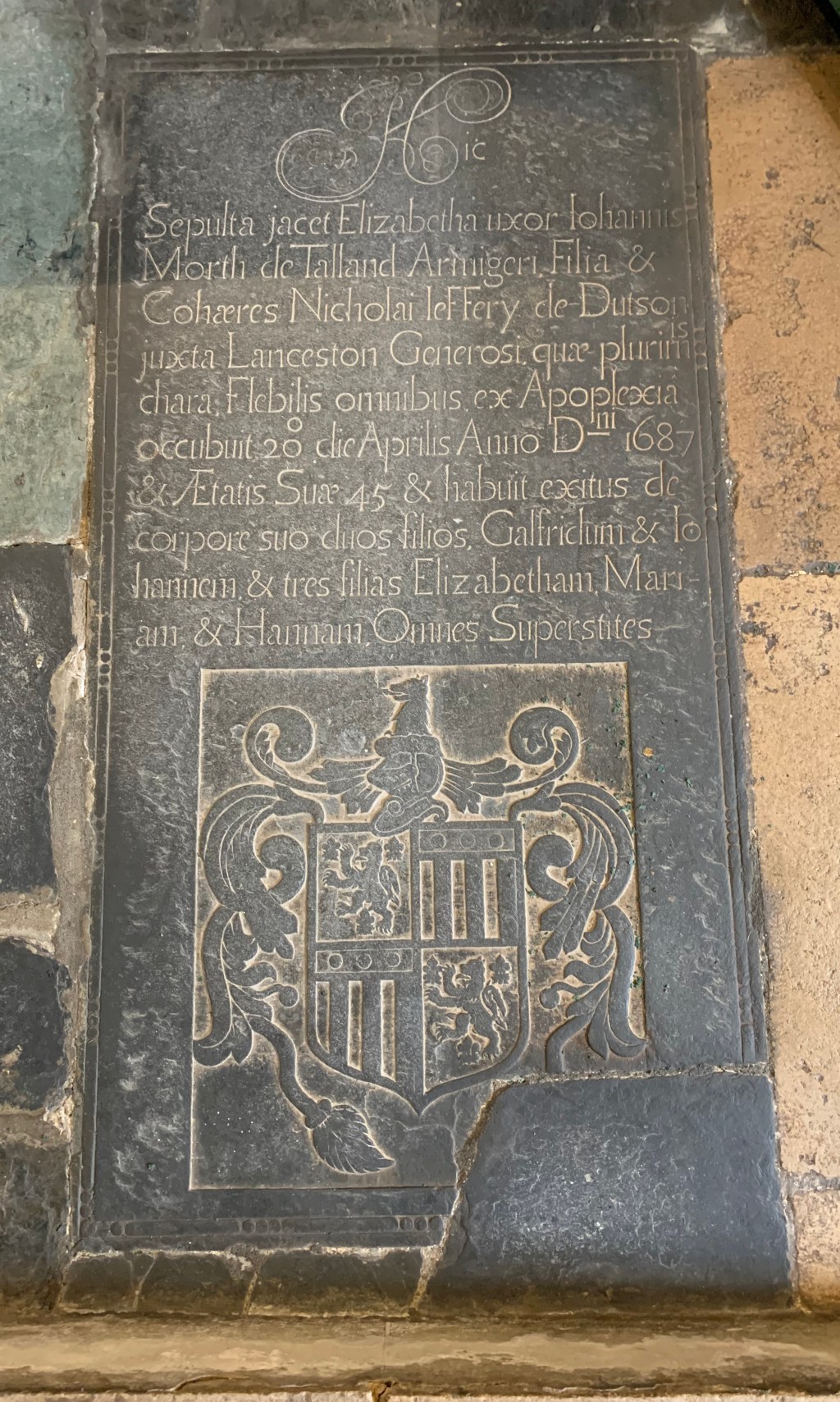
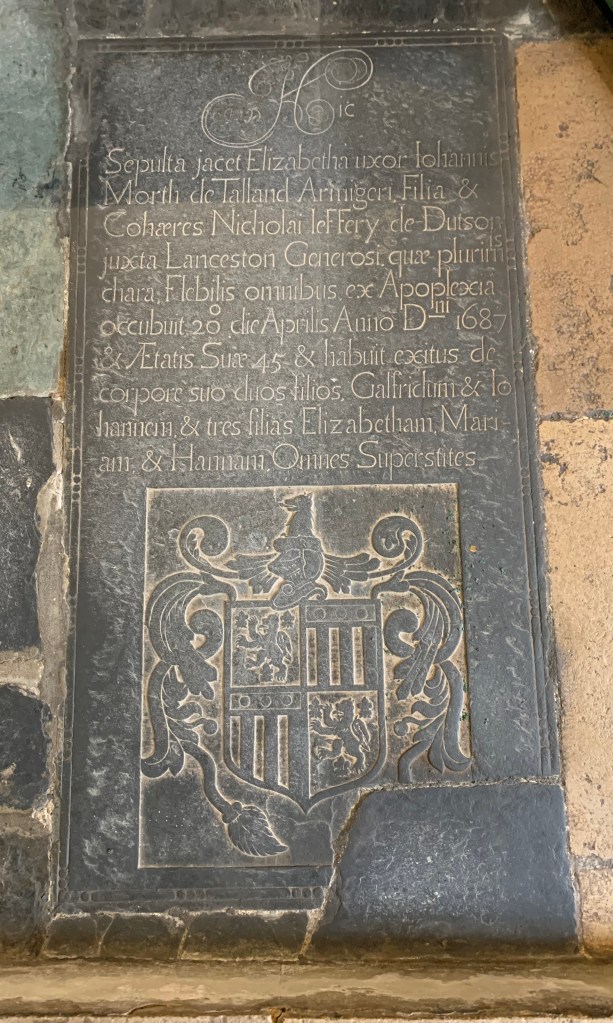
~ Slate ~ Incised Latin inscription, above bas-relief heraldic decorative panel, depicting the quarterings of the Morth & possibly Jeffery coat of arms, set within a rectangular slab, bordered with alternate roundel & double line incised design. Missing bottom right-hand corner.
~ Orientation ~ West/East ~ in front of chancel steps ~ 164 x 84 cms // 5’4″ x 2’8″
- Elizabeth Morth 1642 – 20 April 1687
- Parish Records show
- Buried 23 April 1687
- Wife of John
Buried here lies Elizabeth, wife of John
Morth Esquire of Talland, daughter and
co-heir of Nicholas Jeffery, Gentleman of Dutson
near Launceston, who beloved of many and
mourned by all, died of Apoplexy on the
20 day of April in the year of our Lord 1687
aged 45, and who had given birth
to two sons, Jeffery and John,
and three daughters Elizabeth, Mary
and Hannah, all of whom survived her
translation of Latin script
The slate has clearly defined 17th century script. Taking up nearly half of the tablet is a rectangular panel, depicting the quarterings of two coat of arms, on a 16th century shaped shield, which is surrounded by symmetrically designed supporting scrolled foliage, leading into a tail of a lion at the base. A helmet, with visor closed, denoting a gentleman or esquire, is adorned with a crest of a wolf’s head at the top of the armorial achievement. The bottom right-hand corner is missing and has been patched with unmarked slate. The slab is positioned in front of the chancel steps.
Blazon: (Argent), a lion rampant, between 3 fleurs-de-lys, (Gules) [Morth coat of arms]
quartering
Blazon: with paly, in chief 3 plates [Unknown coat of arms]
‘Lake’s Parochial History of the County of Cornwall, History of Talland. Vol IV. Published 1838 –
a compilation of writings by British historians William Hals (1655-1737) & Thomas Tonkin (1678-1742) – Pub. 1838. Tonkin was a Cornish Landowner and wrote (from 1700’s) many manuscripts; his writings are also found collated in an edition of Richard Carew’s Survey of Cornwall. The transcription of the Elizabeth Morth stone was part of the Additions written by author Davies Gilbert (1767-1839 Cornish engineer, author & politician).
The Morth coat of arms can be found in the ‘Visitations of Cornwall,’ LtCol. J L Vivian Pub 1887. Pedigrees contained in The Herald’s Visitations made in 1530, 1573 & 1620, collated by the College of Arms.
The description of the unknown coat of arms blazon has been confirmed by the Rouge Dragon Pursuivant, at The College of Arms as ‘paly on a chief of three roundels’ adding “the design may never have been officially granted – because of the very simple design of the arms in question, and because no colours can be discerned from the engraving, there are likely to be multiple possible candidates for the bearers of such a design. There is also the possibility that the arms were borne without the heralds’ authority, which would reduce the chances of the bearers in this particular instance being on record at the College. A heiress is mentioned in the inscription, from the Jeffery family, but this does not necessarily mean that the quarters in question pertain to Jeffery.
The Morth coat of arms can be found in the ‘Visitations of Cornwall,’ LtCol. J L Vivian Pub 1887. Pedigrees contained in The Herald’s Visitations made in 1530, 1573 & 1620, collated by the College of Arms.
Talland Parish Records show Elizabeth Morth was buried on 23rd May 1687 “wife of John” ; the ledger stone reads that she died on 20th April 1687.
John Morthe of Talland was High Sheriff of Cornwall in 1696. (Visitations of Cornwall)
In the 17th century the Manor of Talland was the home of the Murth / Morth(e) family, and is referred to in the ‘Survey of Cornwall’ by Richard Carew (1552-1602). In 1745 the daughter & heiress Margery Morth marries John Woollcombe – on the Tithe Map of 1840, Charles A’Lee (1783-1860) was renting the farm and house from the Woollcombe family. Headstone 296
“John Morth or Murth, Free Tenant of West Looe, 1615. The name of this family frequently appears on the list of Free Tenants in the xvii. century. They owned the manor of Talland. Jeffery Murth, the last of the male line, died in 1748, On the floor of Talland Church are laid several stones commemorating departed Murths.”
Corporation Chronicles: Ancient Corporations of East & West Looe – 1904
 Talland Church Headstones
Leave a comment