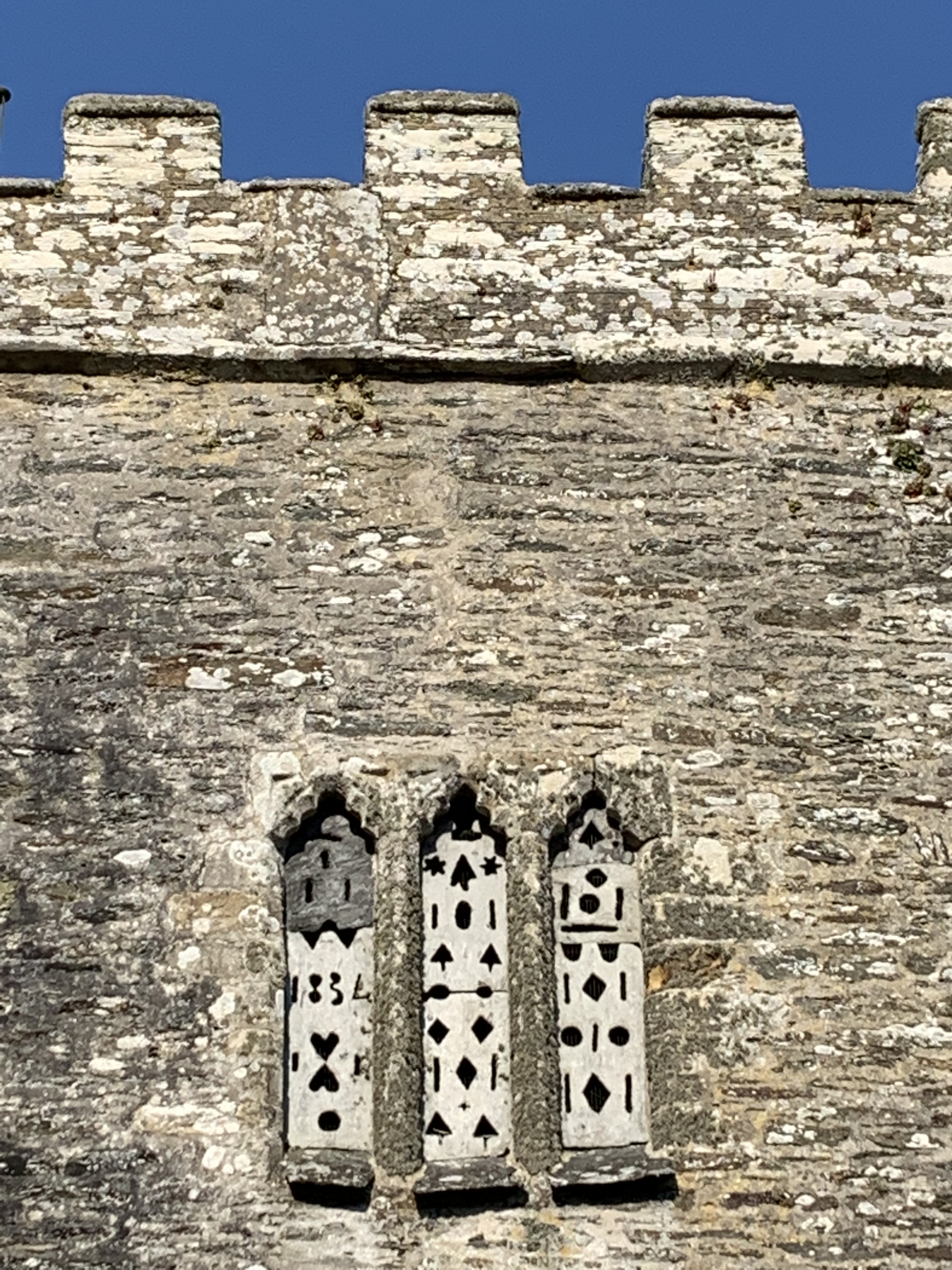
Before the fashion of memorial tombs, the John Bevill Tomb of 1597 being a beautiful example, church memorials were essentially grave markers, a two dimensional rectangular stone slab, laid directly above the grave, inside the church for all to see. Stones with inset brasses first appeared in the 1400’s and wealthy city gentry would portray themselves as important local figures. By the start of the sixteenth century, town merchants and country gentleman esquires also wanted to make their mark and started to copy these statement pieces with simpler slate memorials, the more grandiose being decorated with relief coats of arms as with Ledger Stone 1
Workshops were set up locally, using Catacleuse stone, a very dark blue-green rock and Delabole slate, a distinctive silvery-grey colour from quarries on the north coast; heavy loads were transported by river and pack-horse. These quarries have been worked for hundreds of years and a large export trade had developed by the 1600’s.
Here at Talland our earliest ledger stones are made of incised slate and un-decorated, but quite distinctive and comprise of a marginal inscription surrounding a central dedication.
Sadly not one of them is complete and of the few fragments visible not enough information is legible to identify names for absolute certain. From the inscription extracts on view, we can tell each stone would have varied in size, the borders appear to be different widths and the marginal inscriptions have incised text of varying styles, all in black letter Old English script, which is difficult to read. The earliest detectable date appears to be 1621.
Ledger Stone 22 & 24 & 46 & 47 & 49 & 50 & 51 & 52
~ Slate ~ Fragment of a broken and worn slab. Inscription in larger script runs around the edge in a wide border.
~ Orientation ~ East/West ~ North Aisle ~ 80 x 70cm // 2’8″ x 2’4″
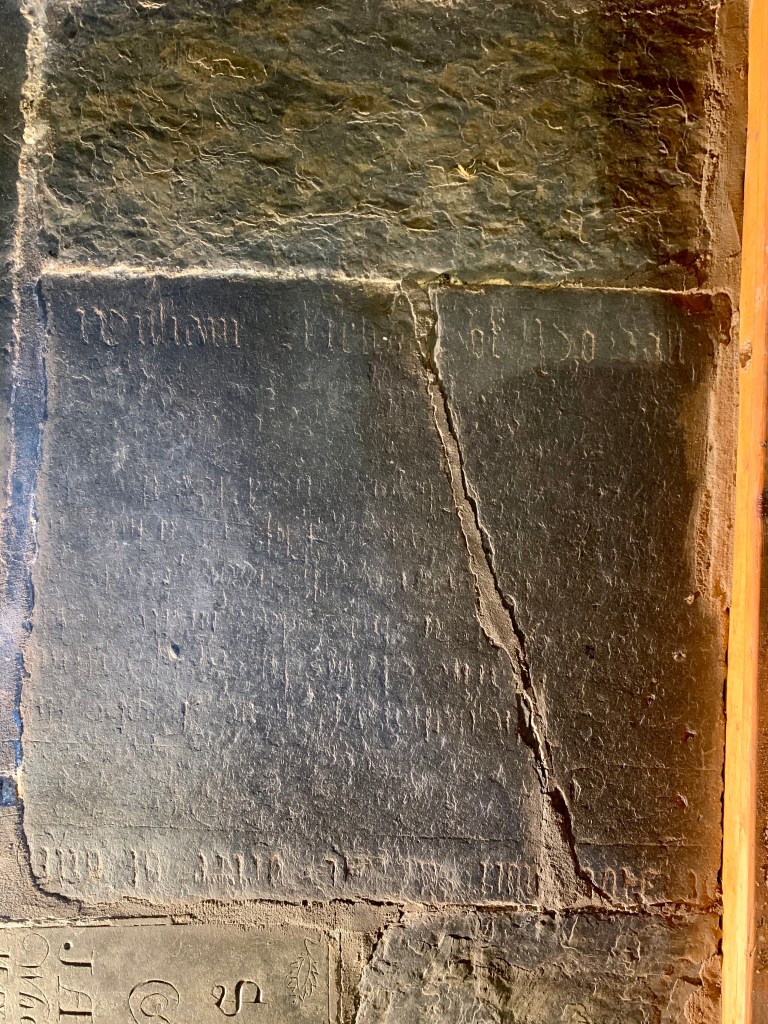
- Ledger Stone 22
- the margin inscription reads:
- ‘William [A….] of Po[rt]all’
From the Will & Burial information available there are no listings of a ‘William’ with a surname beginning with ‘A’, dating from the 1600’s
~ Slate ~ Fragment stone with a wide border containing an inscription, faint, worn and indistinct dedication
~ Orientation ~ North/South ~ North Aisle ~ 98 x 80 cm // 3’3″ x 2’8″
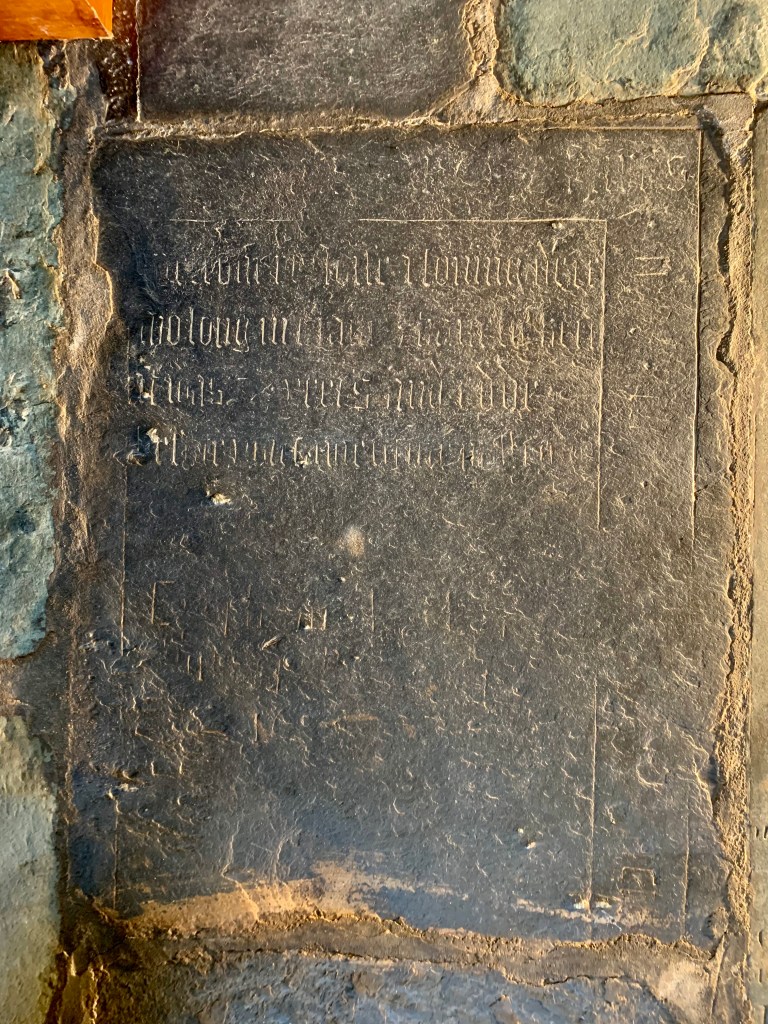
- Ledger Stone 24
~ Slate ~ A large fragment of a large stone with 17th century medieval script, which is worn and unclear
~ Orientation ~ East/West ~ North Aisle ~ 55 x 132 cm // 1’10” x 4’4″
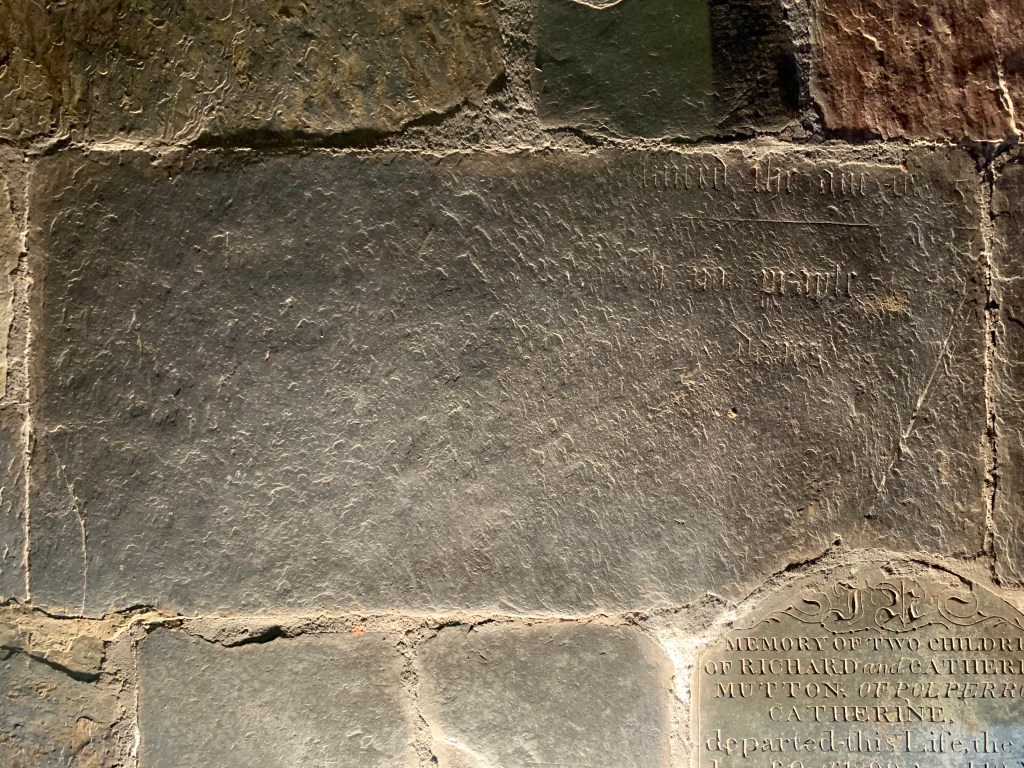
- Ledger Stone 46
~ Slate ~ Small fragment of a much larger stone, 17th century medieval script at an acute angle to cut edges
~ Orientation ~ West/East ~ North Aisle ~ 29 x 37 cm // 11” x 1’3″
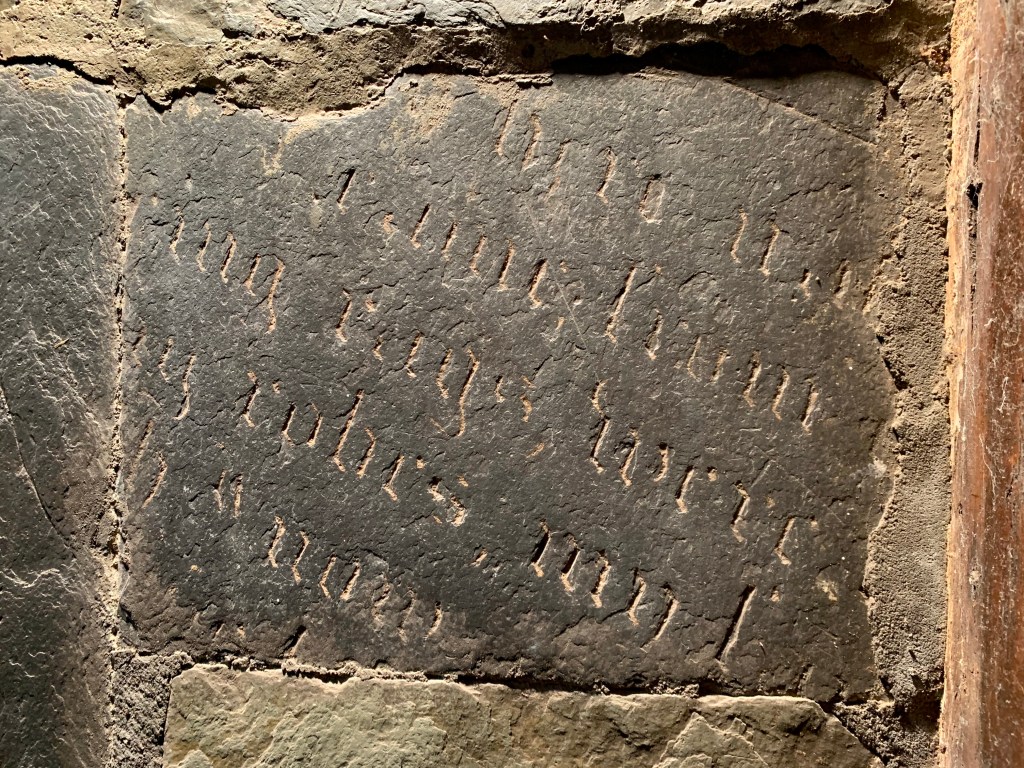
- Ledger Stone 47
~ Slate ~ A small fragment containing the corner of the stone and its wide border inscription in 17th century medieval script
~ Orientation ~ West/East ~ North Aisle ~ 51 x 47 cm // 1’8″ x 1’7″
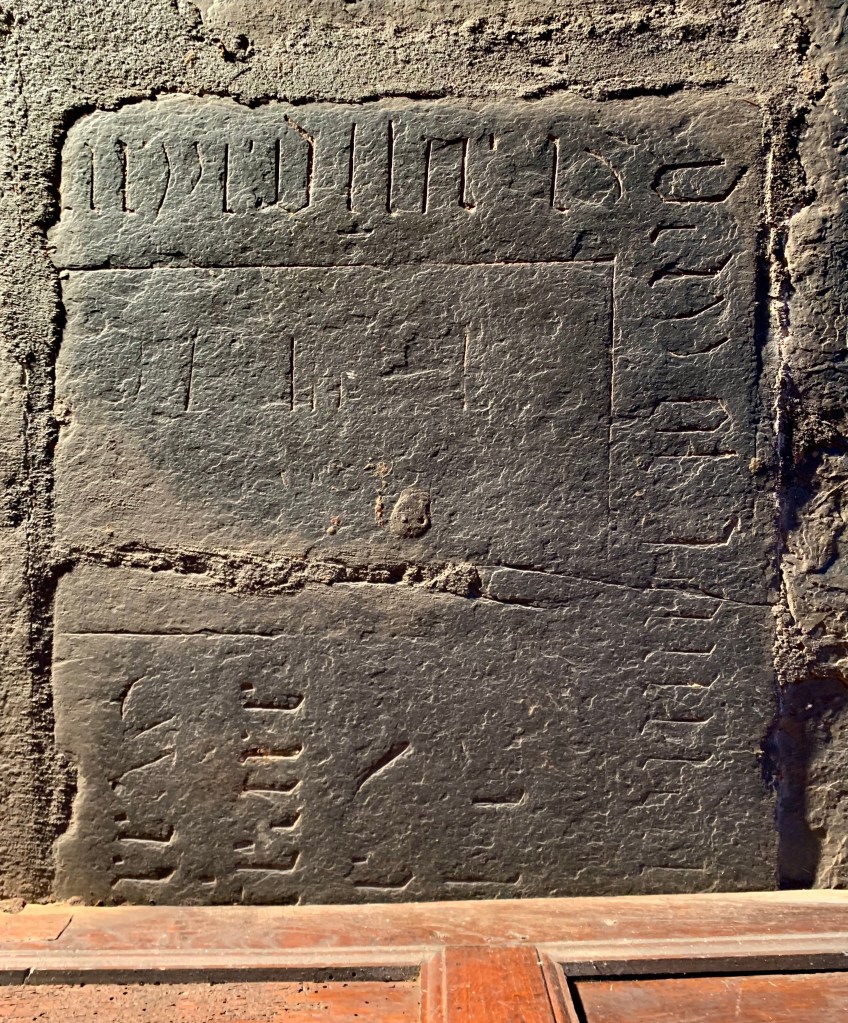
- Ledger Stone 49
- the corner margin inscription reads:
- ‘dyed the 15 // day of January’
~ Slate ~ A small fragment containing the corner of the stone and its wide border inscription in 17th century medieval script
~ Orientation ~ West/East ~ North Aisle ~ 43 x 49 cm // 1’5″ x 1’7″
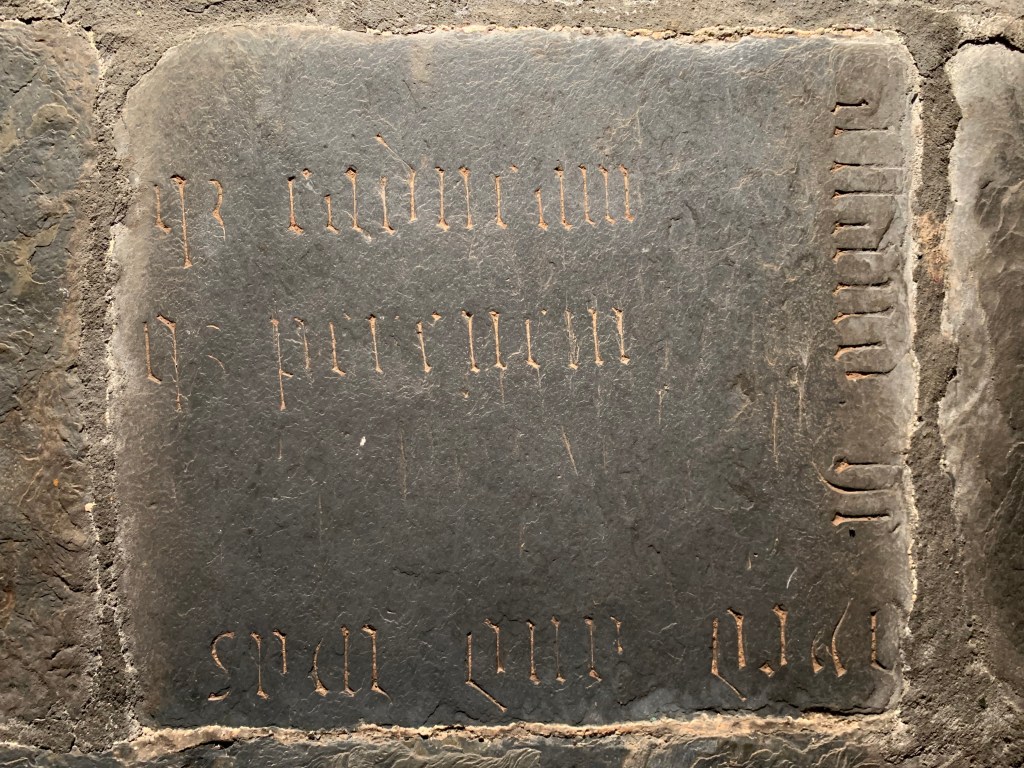
- Ledger Stone 50
- possibly the corner margin inscription reads:
- ‘[T]alland ……. // …. and was’
Although the script is clear, the vertical script is very difficult to decipher
~ Slate ~ A small fragment containing the corner of the stone and its wide border inscription in 17th century medieval script – Dated 1621
~ Orientation ~ South/North ~ North Aisle ~ 80 x 47 cm // 2’8″ x 1’7″
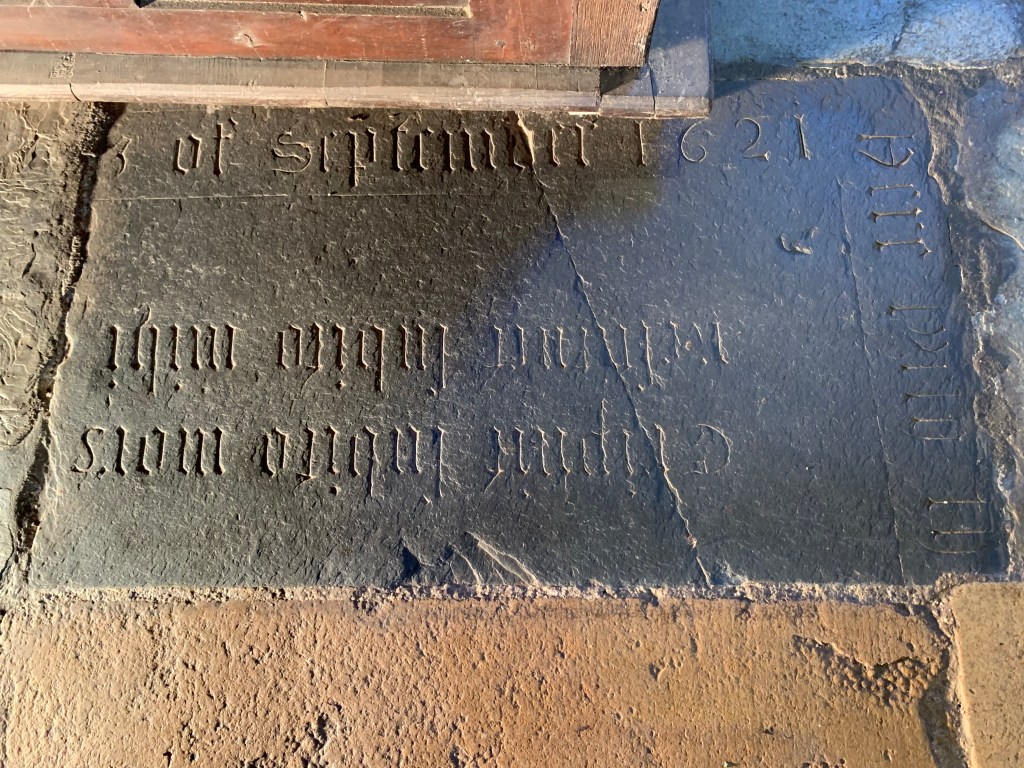
- Ledger Stone 51
- possibly the corner margin inscription reads:
- ‘ ..3 of September 1621 // …with thy …’
The script is large and deeply incised, but difficult to decipher
Wills available at Kresen Kernow include a ‘John Morth, esquire of Talland’ dated 1621 ref: AP/M/355
Possibly related to Elizabeth Morth, Ledger Stone 1, found a few feet away in front of the chancel step
~ Slate ~ A rectangular stone showing a wide border with inscription to three sides containing 17th century medieval script. The dedication around the edge and memorial verse in the centre
~ Orientation ~ North/South ~ North Aisle ~ 100 x 62 cm // 3’3″ x 2′
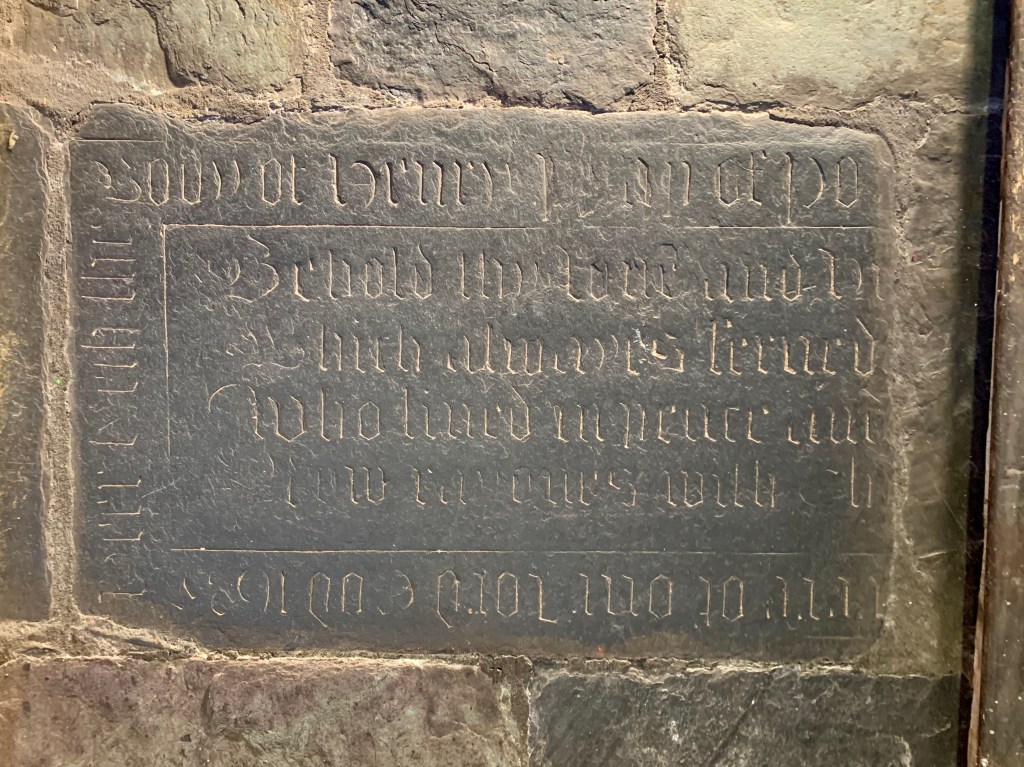
- Ledger Stone 52
- possibly the corner margin inscription reads:
- Here lieth the // Body of Henry [Poap] of Po… // [year] of our lord God 1635′
- possibly the central inscription reads:
- Behold thy Lord and M…
- Which always feared …
- Who lived in peace and …
- Now live always with Ch[rist]’
Wills available at Kresen Kernow include a ‘Henry Poap of Talland’ dated 1635-1636 ref: AP/P/681
 Talland Church Headstones
Leave a comment