A Little Bit of Bevill and Grenville Family History
The Beville family home was France, the Calvados region of Normandy; the family farm produced the countries best dairy products, fit for the King of France.
When King Edward of England died, his cousin William of Normandy, contested the throne, and on September 23 1066, William invaded England. With him were two brothers, Sir ‘Humphery’ and Sir ‘Wiiliam’ de Beville who were knights serving in the Duke of Normandy’s Army – the largest ever army to sail across the English Channel including an assembly of 700 warships, 10,000 men, plus their horses and weapons.
The English were defeated and William the Conqueror became the first Norman King of England. Fighting endured for many years and Sir Humphrey, who served in Cornwall, was made Commander-in-Chief of Truro castle and given land near Kilkhampton, in Devon. The Beville descendants married into the Grenville and Arundel families, all acknowledged at the time as eminent and honourable.
An important acknowledgement of the Beville family name, was evident when Cornwall was represented by Reginald Beville in the English parliament of 1294. A succession of Bevill(e) men were to follow in governmental positions, including John Bevill of Killigarth (1516-1579), who became Justice of the Peace and High Sheriff of Cornwall in 1558, at a time when the Cornish were rebelling in opposition to the Protestant Book of Common Prayer. He had been brought up in the Roman Catholic faith, attending mass at Talland Church. In 1564, he was described by the Bishop of Exeter, William Alley (1501-1570) in his letters to the Privy Council, as a “very great enemy” to the ‘reformed church’, he eventually changed his allegiances and was appointed High Sheriff for the second time in 1575.
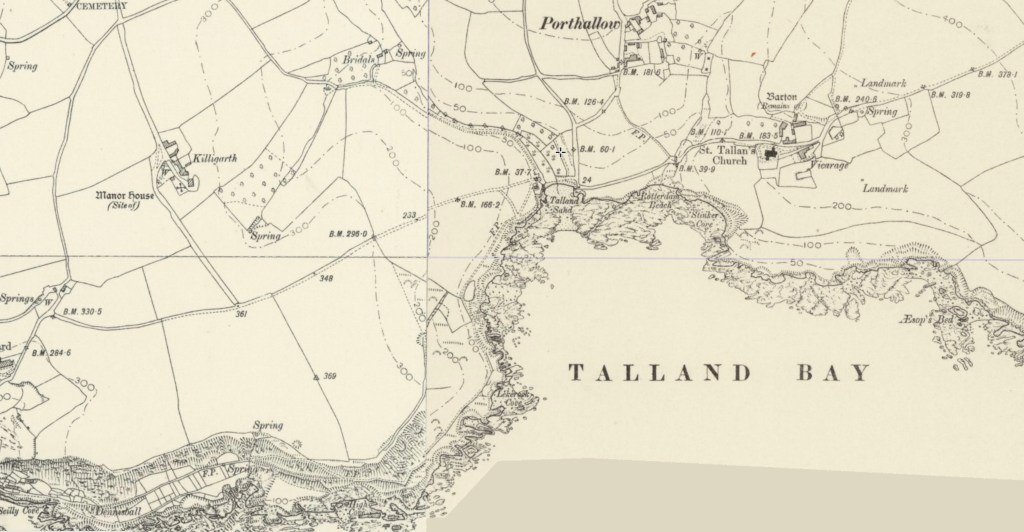
John Bevill was the son of Peter Beville, of Gwarnack and Philippa Bere (1491-1553), daughter of John Beare of Pengelley & Killigarth. The family Bevill heraldic crest combines both the (Beville/Bevill) Ruby Bull and the (Bere/Beare) Black Bear.
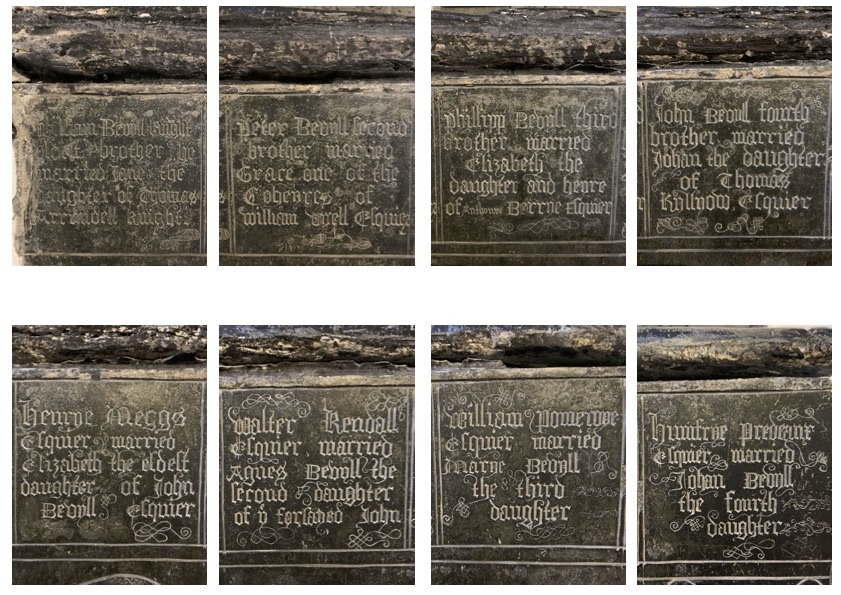
John Bevill, of Killygarth married Elizabeth Milliton (1517-) daughter of John Milliton of Pengersick Castle. John and Elizabeth Bevill had four sons and four daughters, each of their prestigious marriages are celebrated on the John Bevill tomb, located in the south east corner of Talland church.
Note: the males are referred to as ‘brother’, the females ‘daughter’.
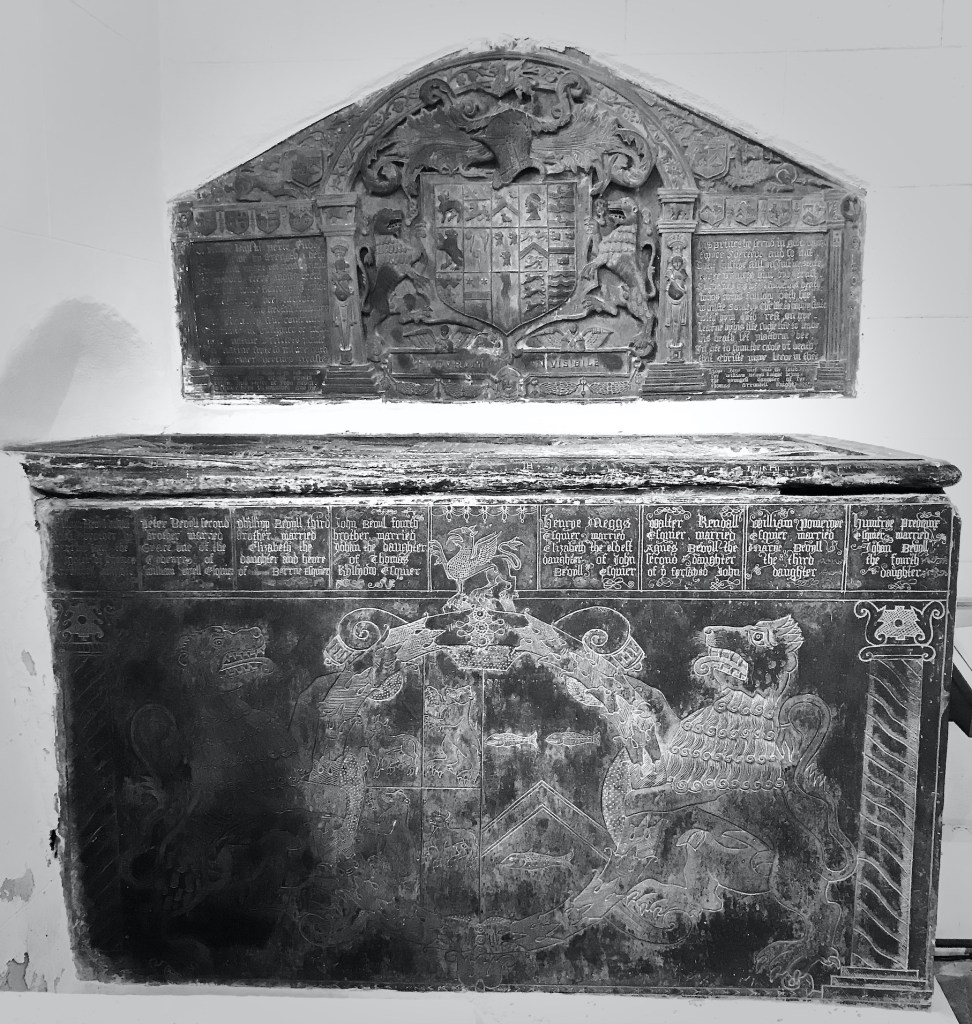
Built of local soft, dark blue slate, in colossal full-length heavy slabs, the tomb chest stands on a plinth and measures 1800L x 800W x 1000H and comprises of one horizontal lid and two side panels, with a wall mounted back plate. The decoration is profuse; high relief carving, elaborately incised detailing with inscriptions and heraldic symbols and coats of arms.
The front side panel has a heraldic achievement relating to John Bevill; the armorial charges central to the slab appear on a large incised shield, surrounded by a wreath of laurel leaves, with decorative scrolled shoulders and curved feet. Between two ornamental pilasters, the centrepiece is topped with a crest of ‘a passant griffin’ standing on a torse, and ferocious looking rampant beasts act as supporters. The armorial shows Bevill quartering Bere and impaling Milliton.
The slate backplate is cut in high relief and contains a large achievement of arms showing fifteen quarterings, generous amounts of foliage behind the family crest, consisting of a decorative incised closed helmet and a passant griffin, supported by two fierce rampant beasts, all set under a decorative semi-circular pediment supported by two pilasters with stepped plinths and in each cornice, a bear. In front of each pilaster stands a carved figure; on the left a male telamon and on the right a female caryatid, indicating an architectural support. To each side of the centrepiece are panels, bordered by ornamental pilasters, containing eulogising verse and an affirmation from the donor. Both inscriptions are incised with a black letter gothic script.
Above each side panel are four shields showing the impaled coats of arms for each of the four sons and four daughters. In the tympanum of the pediment, to each side of the centrepiece, is a shield showing Bevill impaling Militon, supported by a passant beast.
At the base of the centrepiece is a plaque displaying the family motto, guarded by a pair of open winged half-angels, positioned in prayer. The motto reads:
Futurum Invisible
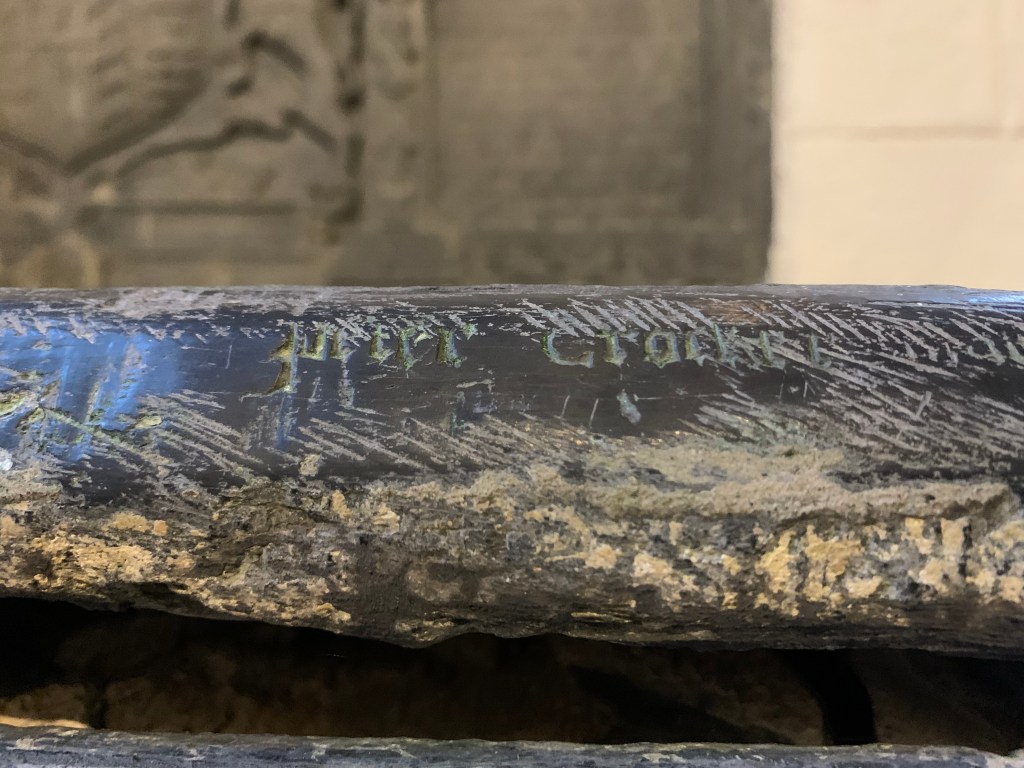
The signature of the carver, local mason, Peter Crocker is visible on the front edge of the tomb. He is know for his characteristic squat Gothic script and highly likely to have had a workshop in Looe, from 1588-92. It is regarded that the inspiration of his work, by taking the architectural features of Classical design, rather than crude woodcuts or religious symbolism, may have come from studying decorative plasterwork available in continental prints, suggesting perhaps that he was also a stone carver or plasterwork sculptor in large country houses. Other tomb work attributed to him are found at the churches of Lansallos, Pelynt, Duloe and St. Martin-by-Looe.
The top panel boasts a full length image of John Bevill, Esq. with a moustache and beard, in an extremely elaborately, embossed and embellished Elizabethan suit of armour. The tomb suggests a man of importance, his unimaginably expensive ornamental armour is decorated with extravagant patterns of Tudor contemporary fashion; at this time Queen Elizabeth I would gift a license to enable noblemen and knights to wear such lavish ceremonial armour.
He has a sword on his left side and dagger on his right and his head, surrounded in a large ruff, is resting on a helmet, adorned with a griffin crest. John Bevill’s gloved hands rest on his chest, positioned in devout prayer, they form an arch and so emphasising the Bevill Ruby Bull on his breast plate.
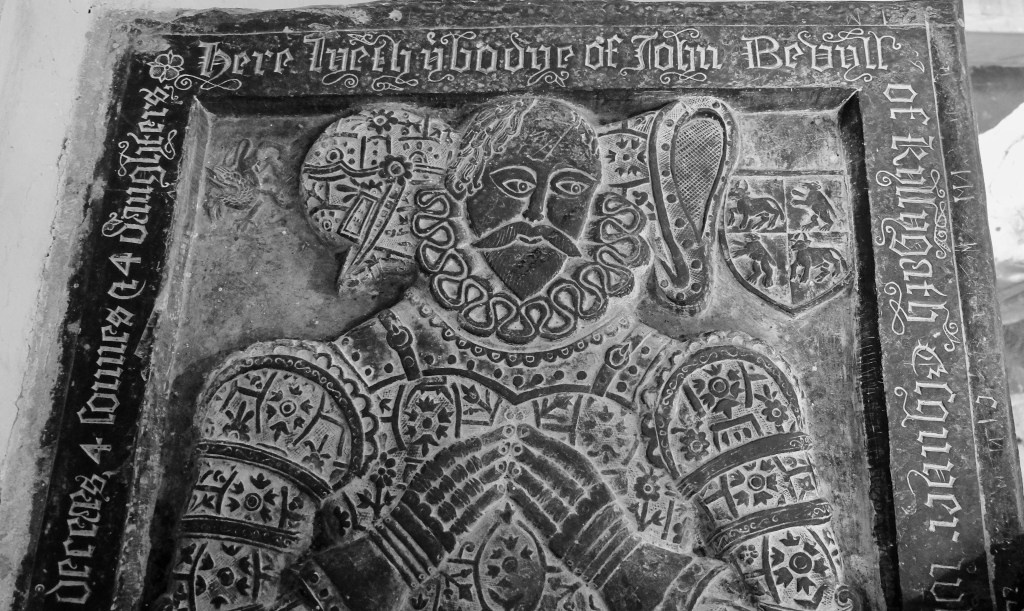
The tomb was constructed ten years after John Bevill’s death and paid for by his first son and heir, Sir William Bevill (1549-1600), a well connected country gentleman living and entertaining at Killigarth Manor; his father’s tomb would have been a great talking point, flaunting his wealth and status. William’s primary job was to help defend the Cornish coast, he was captain of the Talland Militia with six companies and a total of 670 men under his command, including; 225 with pikes, 210 with muskets, and 190 armed with light muskets, called ‘calivers’. In the year of the Spanish Armada, 1588, Elizabeth I had provided Cornwall with firearms and ammunition from her own reserves; the huge Spanish fleet sailed up the Channel, visible from Lansallos and Talland. As well as his militia work, William Bevill became the first Steward of the new Borough of West Looe, 1574, sitting at frequent court cases; Justice of the Peace of Cornwall from 1583, and High Sheriff of Cornwall in 1589 & 1598. He was Knighted in 1589, so helping to authorised the date of the tomb, however, importantly, he did not produce an heir. His first wife Jane Arundell (1542-1597) was the daughter of Thomas Arundell (1502-1552) who was convicted of conspiring to overthrow the government and was beheaded on Tower Hill. His second wife Frances Knyvet (1583-1605) was about 17years old, William 52, when they married in 1600; William died 6months later.
John Bevill’s second son Peter Bevill (1549-1597) did not produce an heir either, it was third son Philip Bevill (1550-1617) who came to live at Killigarth Manor.
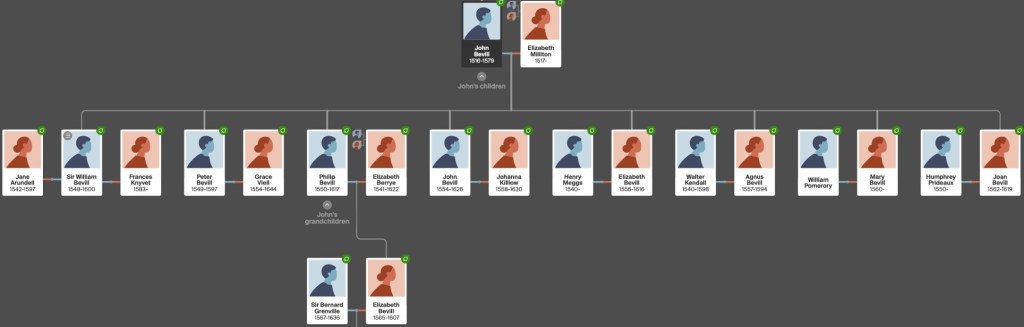
Philip Bevill married Elizabeth Berrye (1541-1622) and they had just one daughter Elizabeth Bevill (1565-1607). Cleverly Philip willed his legacy of the Killigarth estate, before her death, to her husband Sir Bernard Grenville (1567-1636). The estate included thousands of acres of arable land, meadows, heathland, woodland and mills, in more than a hundred Cornish manors spread over a wide area. Killigarth Manor in 1591 consisted of Pleaton, Sutton, Brent, Bridewell, Killigarth Mill, the Pound, Trerust, part of Polperro, Menadue, Mortha, Polkeeves, Polpucky, Trelay and Newton.
Sir Bernard Grenville, was the eldest son & heir of Sir Richard Grenville (1542-1591), privateer, explorer and Lord of the Manor at Stowe, Cornwall. Before setting sail in the Revenge, Sir Richard had arranged for his son to marry Elizabeth Bevill, heiress; they married on 10th July 1592 in Withiel Church. Barnard Grenville was then 24. He was elected member of parliament for Bodmin, Cornwall, in 1597, Justice of the Peace and Deputy Lieutenant of Cornwall in 1598. He was Marshall of the Cornish Militia under his cousin, Sir Walter Raleigh, commanding a thousand men. He was knighted in 1608 and became Gentleman of the Privy Chamber to King Charles I in 1628. Elizabeth & Bernard’s son Bevil Grenville (1596-1643) became leader of the Cornish Royalist army in the English Civil War.
Although the Bevill named ended, the ancestral heraldic ornamentation of Talland church continued.
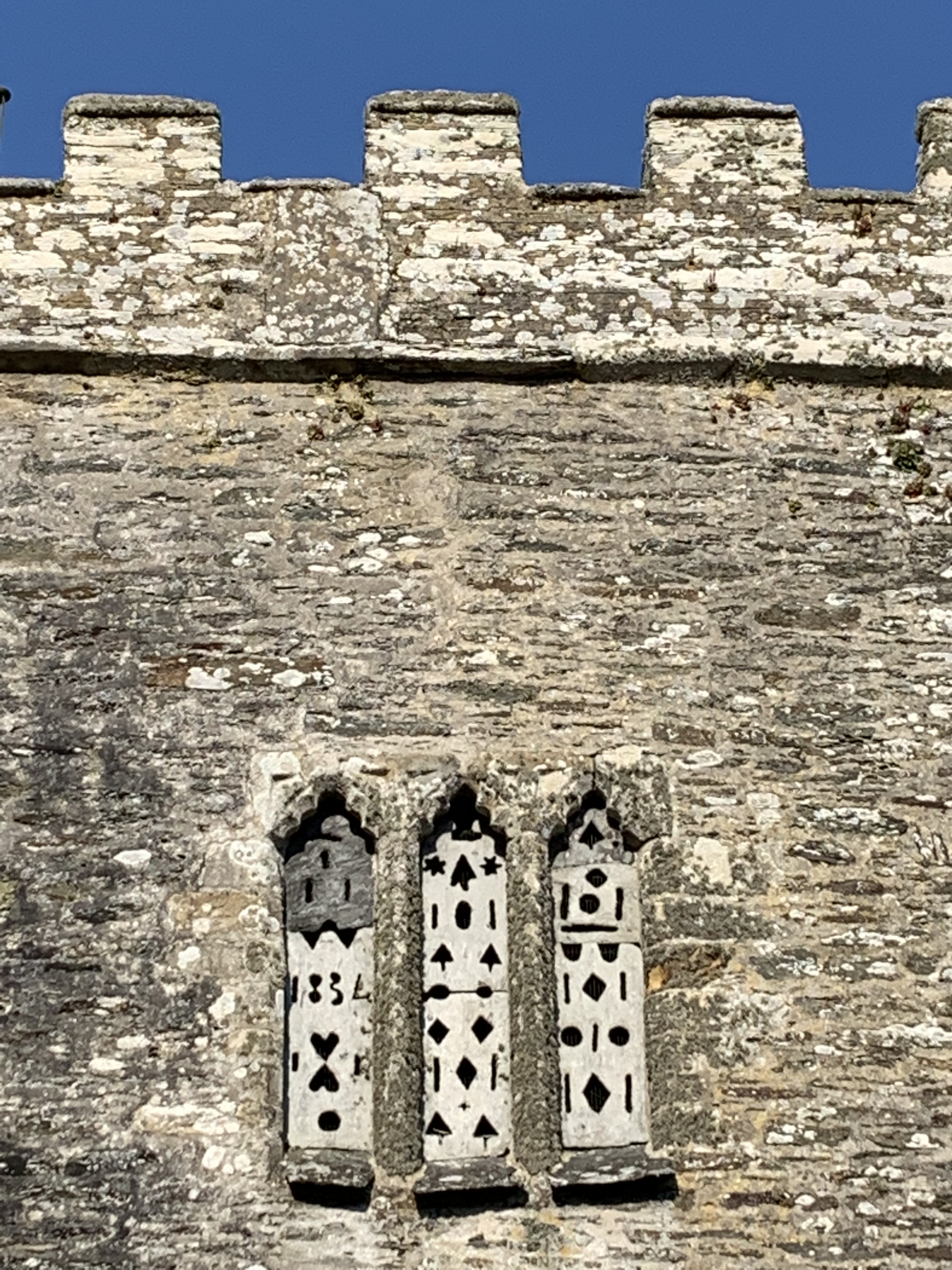
The small Cornish medieval parish church at Talland dates back to 13th century and consisted of a Nave with religious colourful frescos painted on the north wall; there were few windows and the Cornish parishioners would be standing when worshiping each day, in the 1300’s an Early English woodwork rood screen stood in front of the altar. A new South aisle with it’s barrelled roof was added between 1450-1500 and then large windows and Cornish oak benches dating to the 1550’s; the Tudors excelled with exceptionally carved Renaissance scrollwork on each bench end, some are adorned with poppyheads. However, many refurbishments in the 19th century were “clumsy”; the singing gallery was lost, and panels from the rood screen, three-decker pulpit and outdated family box pews were reused to form the choir stall and pulpit. The position of the benches have moved several times over the years.
In the north chancel, the Killigarth Chapel benches display and capture the new fashion of the times in the early 1600’s: heraldic tinctures; the exacting art of correctly notating and colouring heraldic design.
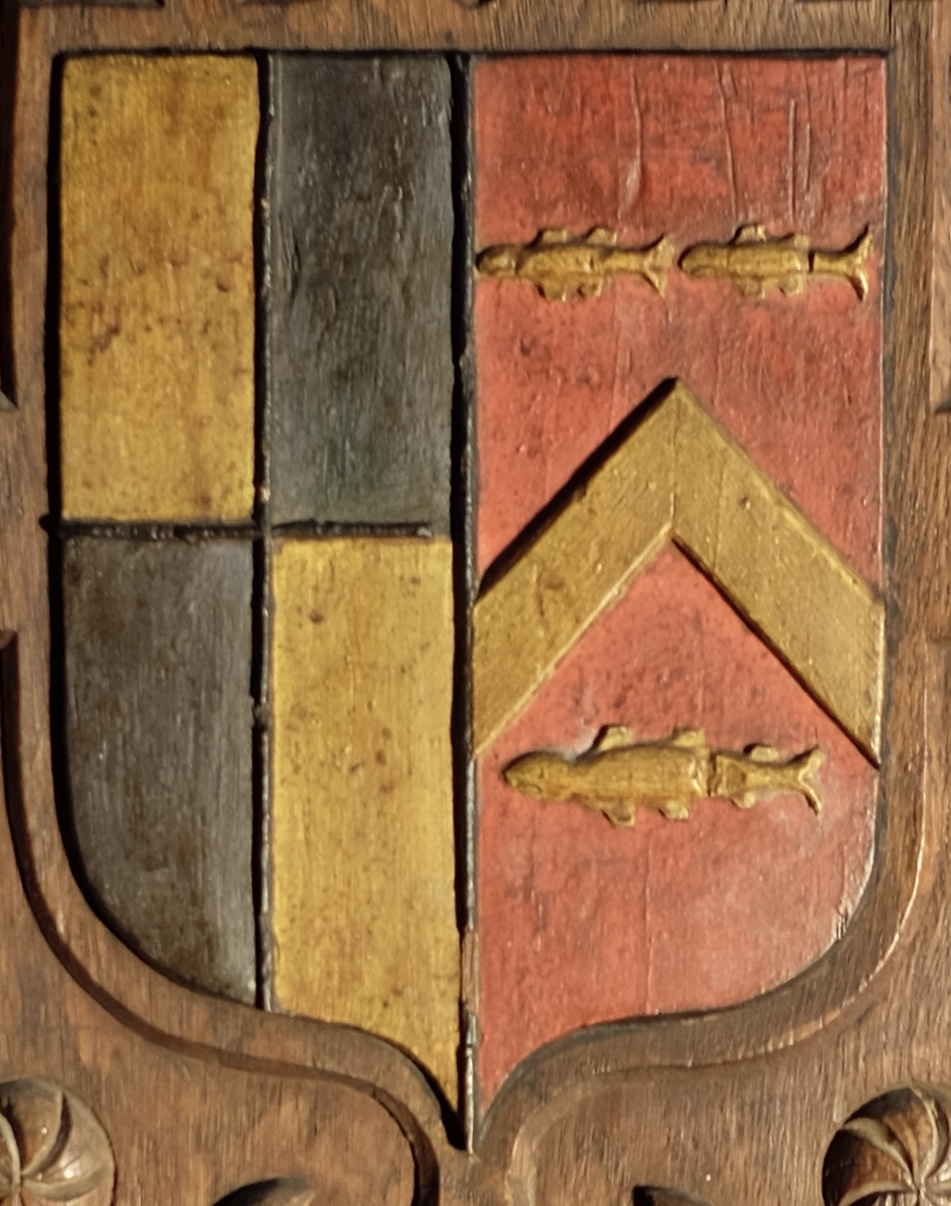
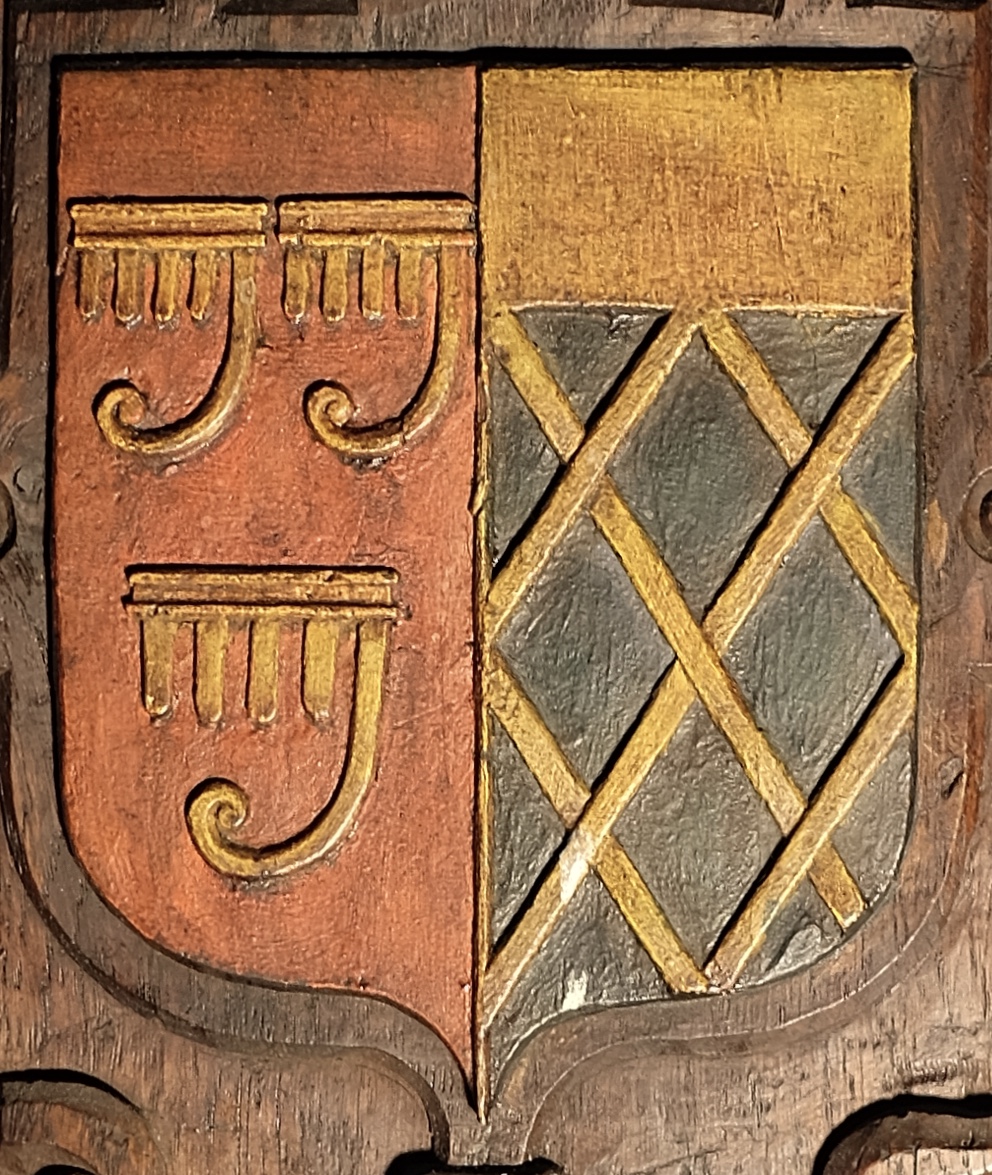
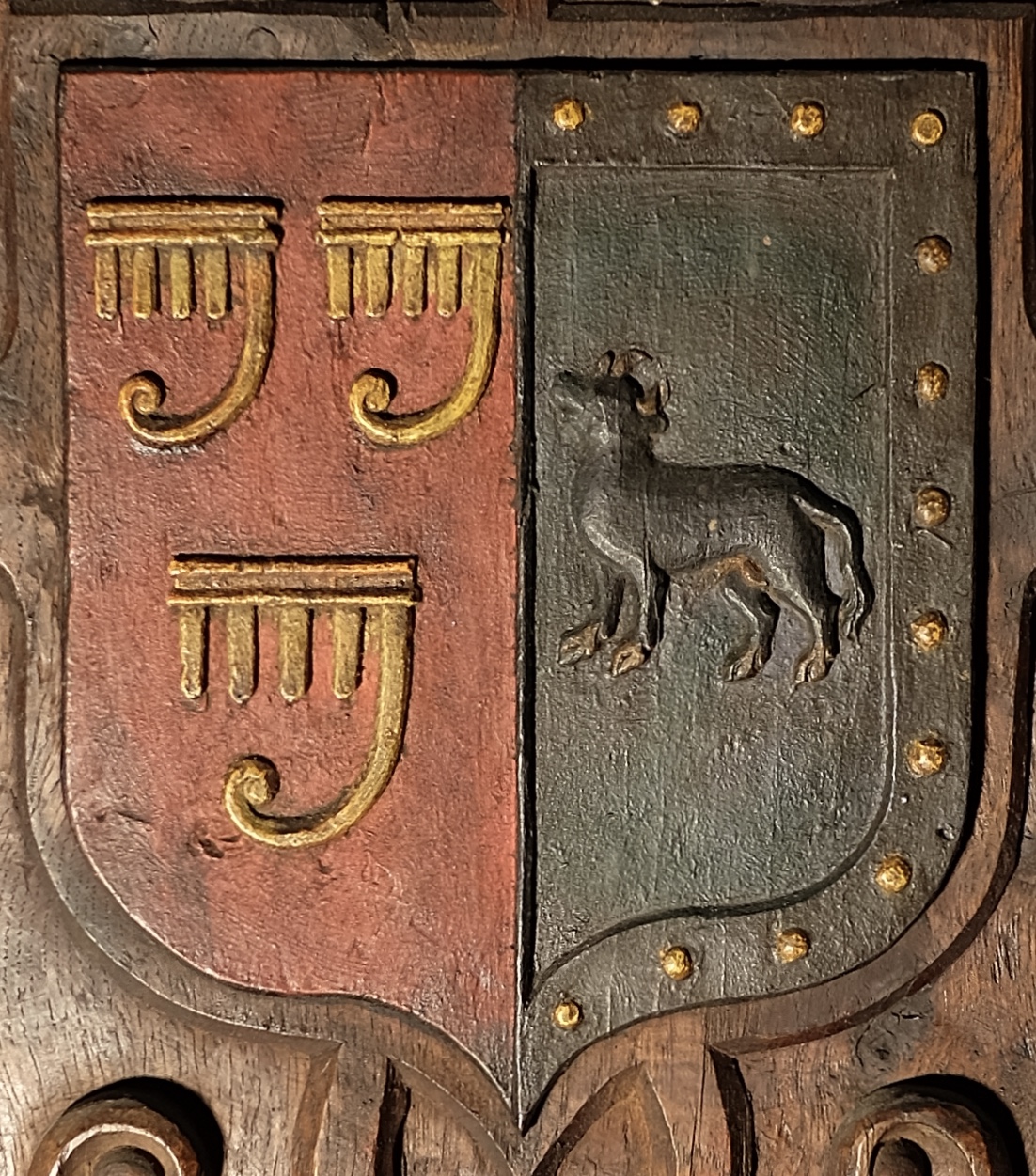


Sir Bernard Grenville, an English politician, was very keen to portray the union of the Bevill and Grenville ancestry; his decoration to the bench ends in the north chancel date from the Stuart Period. Each bench end panel is embellished with a carved and painted heraldic shield surrounded by geometric decorative strap work. The heraldry is showing the impaling (the division of a shield into two equal parts) of two family crests through marriage; each individual is named with a black hand drawn ink inscription. More complex family trees are depicted on the larger shields now decorating the choir stalls.
Our tangled family tree of the Bevill and Grenville descendants starts with Peter Beville (1426-1515), the grandfather of John Bevill of Killigarth.
Peter Bevill married twice and each family line produced offspring that would see a female Bevill marrying a male Grenville.
Sir Bernard Grenville (Peter Bevill’s great, great, great grandson) married Elizabeth Bevill (Peter Bevill’s great great granddaughter) and their first born son was named (Sir) Bevil Grenville (1596-1643), a mix of both the Bevill and Grenville ancestral names.
As a young boy, Bevil Grenville lived at Killigarth manor, and sat in of his own bench, in Killigarth Chapel. He would have learnt about his Grenville history.
His grandfather, was the Elizabethan naval hero, explorer Admiral Sir Richard Grenville (1542-1591) of the galleon ‘Revenge’, who was mortally wounded in the battle of the Azores, who knows, perhaps he visited Talland church.
And, his great grandfather Admiral Sir Roger Grenville (1516-1545) who was Master of the ‘Mary Rose‘, Henry VIII’s favourite warship, when it sank, by accident, in Portsmouth harbour in 1545.
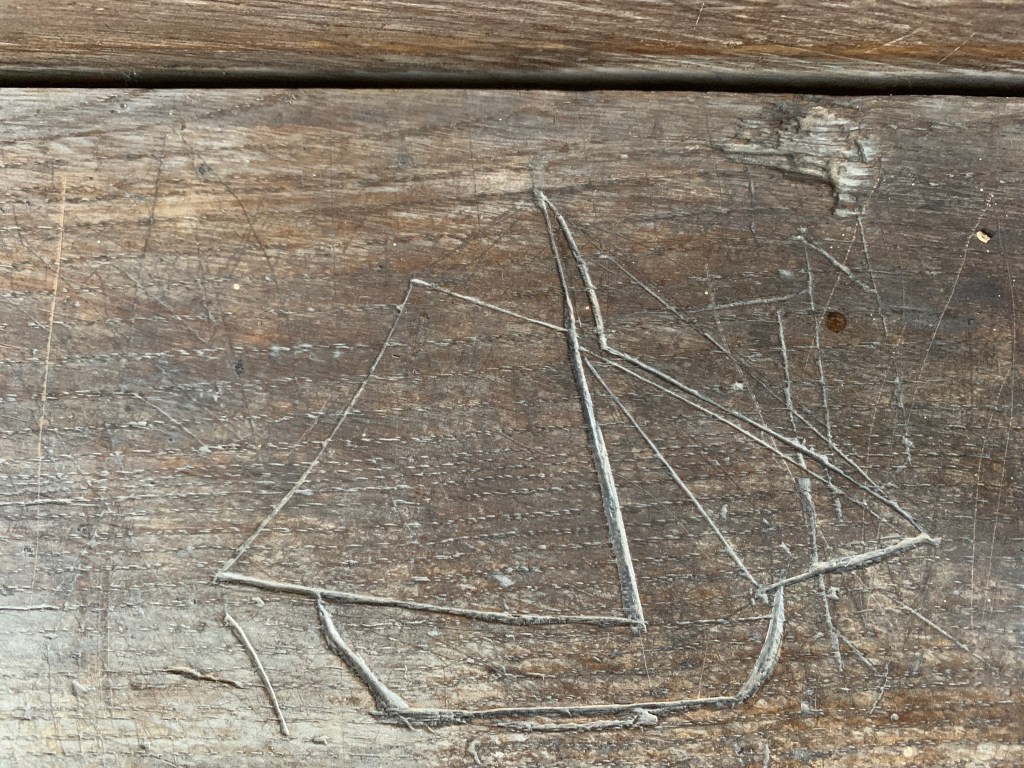
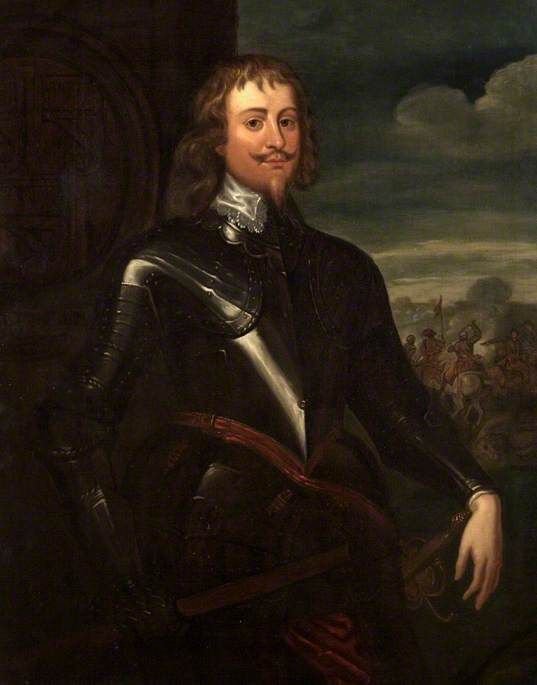
Sir Bevil Grenville became Colonel in the Cornish Royalist army in the Civil War raising a troop of Cornish infantrymen, in support of Charles I.
He was a well respected and very successful commander until his death in the Battle of Lansdowne in 1643.
A 25 foot high monument marks the spot, bearing an inscription describing the battle, and a griffin, displaying the Grenville coat of arms, is mounted on the top.
Sir Bevil Grenville, commemorating the Battle of Lansdown, 1645
Victoria Art Gallery, Bath

‘FUTURUM INVISIBLE’
Further Reading:
- Heralds Visitation of Cornwall – 1620
- British History Online
- Survey of Cornwall, R.Carew
- Visitation of Cornwall, J.L.Vivian
- Tudor Cornwall: portrait of a society, A.L.Rowse
- Salt in the Cellars, Sheila de Burlet
- The Almain Armourers’ Album – V&A
- Memorialisation and the Cornish Funeral Monument Industry 1497-1660, Paul Cockerham
- British Civil War Memorials
 Talland Church Headstones